

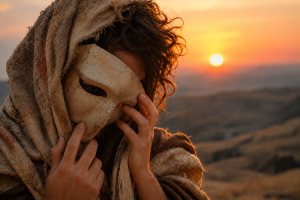

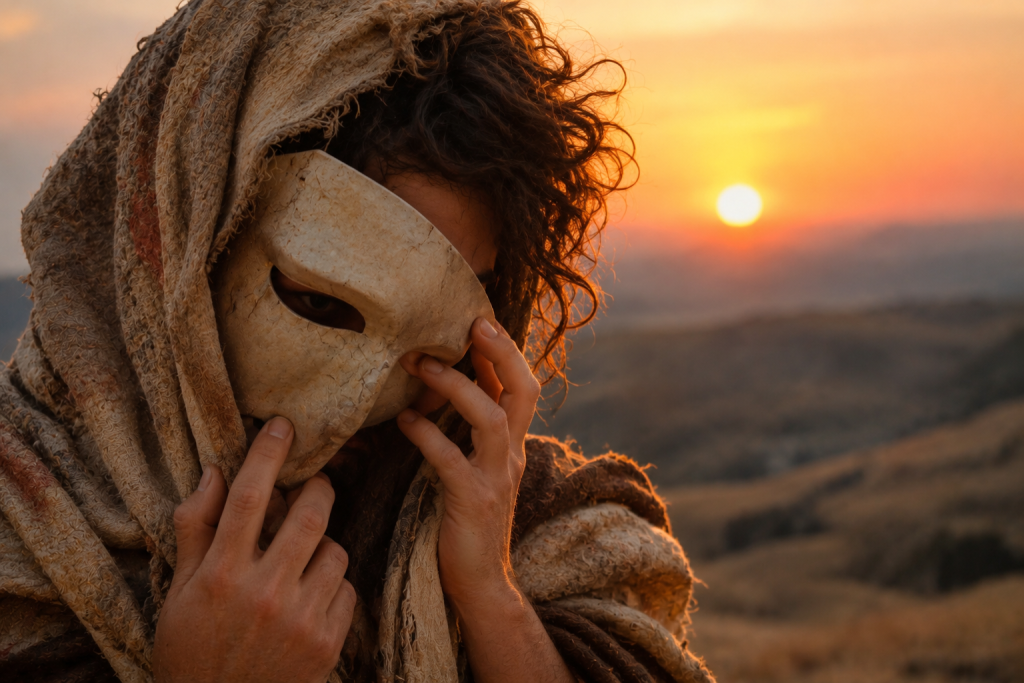
How often in our lives do we wear a mask?
We present ourselves to the world as someone slightly different from who we really are, hoping to gain appreciation, recognition, or approval. Or perhaps to avoid rejection, criticism, or failure.
But what lies behind this need to disguise ourselves?
Could it be the fear that if others saw us as we truly are, they might not love us? That perhaps who we are is simply not good enough?
These thoughts came to mind as I reread the story of Jacob.
In last week’s Torah portion, Toldot, Jacob wants to receive his father’s blessing, which was intended for his brother Esau.
To achieve this, he puts on Esau’s clothes, covers his hands with goatskins, and enters the room of his blind father.
When Isaac asks him, “Who are you, my son?” Jacob replies, “I am Esau, your firstborn.”
And I wonder: Does Jacob believe that his father would not bless him if he stood before him as Jacob? Deep in his heart, doesn’t he long to receive the blessing for who he truly is?
And now, in this week’s Torah portion, Jacob is forced to flee his home.
“And Jacob left Beersheba and went toward Haran.”
But who is the Jacob who leaves Beersheba?
Has he already taken off Esau’s clothes, not only physically but also psychologically? Or is he still carrying within him the false identity he assumed?
After all, clothes can be removed in an instant. But the masks we wear are much harder to take off.
Jacob sets out on a long journey into the unknown. He leaves his parents’ home and the role he has played within his family.
And on the very first night, he dreams of a ladder reaching toward heaven and hears God’s promise:
“I am with you… for I will not forsake you.”
Perhaps this is the beginning of his realization that he does not need to be Esau in order to receive a blessing.
That Jacob, just as he is, is worthy of it.
But the journey toward his authentic self is still a long one.
He arrives at Laban’s home, falls in love with Rachel, and works for seven years in order to marry her.
Then, on their wedding night, under the cover of darkness, Laban substitutes Leah for Rachel.
Only in the morning does Jacob discover the truth:
“And in the morning, behold, it was Leah!”
Jacob cries out to Laban, “Why have you deceived me?”
And Laban replies:
“It is not done in our country to give the younger before the firstborn.”
What irony!
Jacob, the younger brother who disguised himself as his older brother, is now told that the younger cannot come before the older.
And there is another fascinating parallel.
Jacob used clothing to conceal his identity from his blind father, while Laban uses darkness to conceal Leah’s identity from Jacob.
The deceiver has become the deceived.
And I wonder: Does Jacob suddenly see himself?
Does Laban’s deception hold up a mirror in which Jacob can recognize what he himself did to his father and brother?
In psychodrama, there is a technique called role reversal.
When a person steps into someone else’s role, they can experience the story from a different perspective, and sometimes discover something they were unable to see before.
Perhaps this is what life is offering Jacob: an opportunity to experience the other side of deception.
But is he able to look into that mirror and recognize himself?
The Torah does not tell us.
Jacob’s journey continues for many more years, and only in next week’s portion, Vayishlach, does he reach a decisive moment.
At night, on the banks of the Jabbok River, he wrestles with a mysterious figure who asks him:
“What is your name?”
And now, when he is once again asked about his identity, he simply answers:
“Jacob.”
This time, he is not pretending to be someone else.
He speaks his own name.
And only then does he receive a new name: Israel.
Perhaps this is the culmination of his Hero’s Journey.
A journey in which he is forced to confront his fears, his weaknesses, his acts of deception, and also his strengths.
And perhaps this is the journey each of us must undertake.
To recognize the masks we wear, to understand why we once needed them, and gradually to find the courage to remove them.
Because sometimes, in order to receive our true blessing, we must first be willing to be who we really are.